|
 Cutch is an important historical brown dye that comes from the heartwood of the cutch tree (Acacia catechu). It is a very easy dye to use and it is both light-fast and wash-fast, as well as being inexpensive. Cutch is an excellent dye for cottons as it is high in tannins, and it is also suitable for silk and wool. Cutch is an important historical brown dye that comes from the heartwood of the cutch tree (Acacia catechu). It is a very easy dye to use and it is both light-fast and wash-fast, as well as being inexpensive. Cutch is an excellent dye for cottons as it is high in tannins, and it is also suitable for silk and wool.
a) Biology of Cutch
b) Manufacture of Cutch Extract
c) History of Cutch Dye
d) Dyeing with Cutch
a) Biology of Cutch
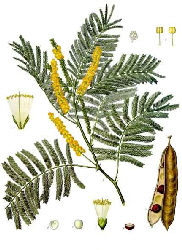
Cutch comes from a small thorny tree of the Leguminosae family and it is native to Asia. The leaves consist of multiple pairs of leaflets and the flowers are yellow and mimosa-like.
A similar dye is produced from the unrelated Asian betel palm (Areca catechu).
b) Manufacture of Cutch extract
The trees are grown in plantations and are cut when they are thirty years old. The bark is removed and then the heartwood is made into wood chips. The dye is extracted by boiling the wood chips in water until the liquid becomes very thick. It is then poured onto mats where the cutch extract hardens as it cools down and can be broken into chunks. The extract is usually sold as a powder but it can also be sold as chips or resin. India is the main producer.
c) History of Cutch Dye
Cutch was used to dye calico in India for centuries and was used extensively in India in the Mughal and pre-Mughal period. It is so important that Kutch, a district of Gujarat in India, was named after the dye. Cutch dye creates the colour khak (or khaki), an Indian word for dust, earth, and ashes. Cutch was used to dye the khaki colour of military uniforms because this colour is difficult to see at a distance and provides a natural camouflage.
 d) Dyeing with Cutch d) Dyeing with Cutch
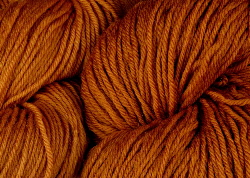
Cutch gives warm golden browns and fawns and it is a very good dye to use in mixtures. Over dyed with indigo it gives beautiful dark grey greens. For dark browns, Liles recommends using a mixture of cutch, logwood and a yellow dye like weld or fustic.
It is used mainly on cotton as it is very high in tannin and can be used as a mordant instead of tannic acid but it can also be used on silk and wool.
Cutch contains two dyes, catechu-tannic acid, which is soluble in cold water, and catechin, which needs hot water to dissolve.
To dye 200 grams of mordanted wool first mix 20 grams of cutch extract into a paste with boiling water and add to dye pot. This paste is a bit sticky, and you may need to keep adding hot water to the paste. Stir the dye pot well to make sure the cutch is well dissolved. Bring to a simmer (the dye becomes deeper and redder the more it is simmered); add the pre-wetted wool and simmer for an hour. Remove the first skein and add a second skein for paler colours.
Cutch is a difficult dye to exhaust and will continue to produce beige colours for several more skeins. Cardon recommends exposing the fibres to the air to oxidise the dye before rinsing the dyed fibres.
Top of page
|