I set up an experiment to check how much wool the different extracts dyed, and how soon they became exhausted. I placed 1 gram of dye extract in a coffee jar, dissolved the extract in warm water and then put the jar in a bain marie. I had previously prepared several dozen 10-metre hanks (about 6 grams each) of handspun Bluefaced Leicester wool, mordanted with alum and with cream of tartar. I placed one pre-soaked 10-metre hank in the jar, simmered it gently for 40 minutes, turned the heat off and left the hank in the dye bath overnight. The next morning I removed that hank and added another one. I repeated this process until the final hank came out a pale colour.
Most extracts produced a wide range of beautiful shades.
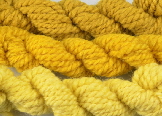
Buckthorn (Persian berries): produced 3 skeins, a bronze yellow, rich orange and pale warm yellow.
Chlorophyllin: I was very impressed with this exciting extract that produced a delightful range of greens, quite different from the range of greens that I get from overdyeing woad and weld. 1 gram of chlorophyllin dyed 4 skeins ranging from forest green to sea green.
Cochineal extract was strong enough to dye 5 skeins with colour variation from deep rose to pale pink using rain water. The water was almost clear at the end.
Coreopsis: produced a warm yellow straight away and was enough for two skeins.
Cutch: produced one medium warm brown skein and two pale brown skeins.
Fustic: produced 3 skeins, ranging from a very strong rich dark yellow to peachy yellow. Those colours are very distinctive from the yellows produced by weld, greenweed or coreopsis.
Gallnut (oak) is mainly used as a mordant, but it produced a pale beige colour, enough for 1 skein only.
Greenweed: like weld, it produced no colour until I added 1 gram of calcium carbonate. A strong extract, producing 4 skeins ranging from bronze-green yellow to primrose yellow.
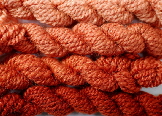
Lac: the first skein was an exciting very dark burgundy red; enough for 4 skeins.
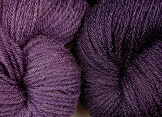
Logwood: 1 gram was enough to dye 7 skeins and even then the dye was not exhausted. The first skein was purplish black, however the exaust dye bath tended to produce very attractive dark and medium browns.
Madder: produced a vibrant colour (temperature kept below 60°C). Strong enough to dye 3-4 skeins – dark, medium, light and pale reds.
Pomegranate: a pale beige colour, enough for 1 skein only.
Sorghum: exciting very dark mauve colour, enough for 4 skeins.
Weld: produced no colour until I added 1 gram of calcium carbonate. Strong enough to dye two skeins, dark neon yellow and pale yellow.
Learn more about dyeing with natural dye extracts: